

Trade Show Graphics Cost: What Goes Into Your Print and Display Quote?
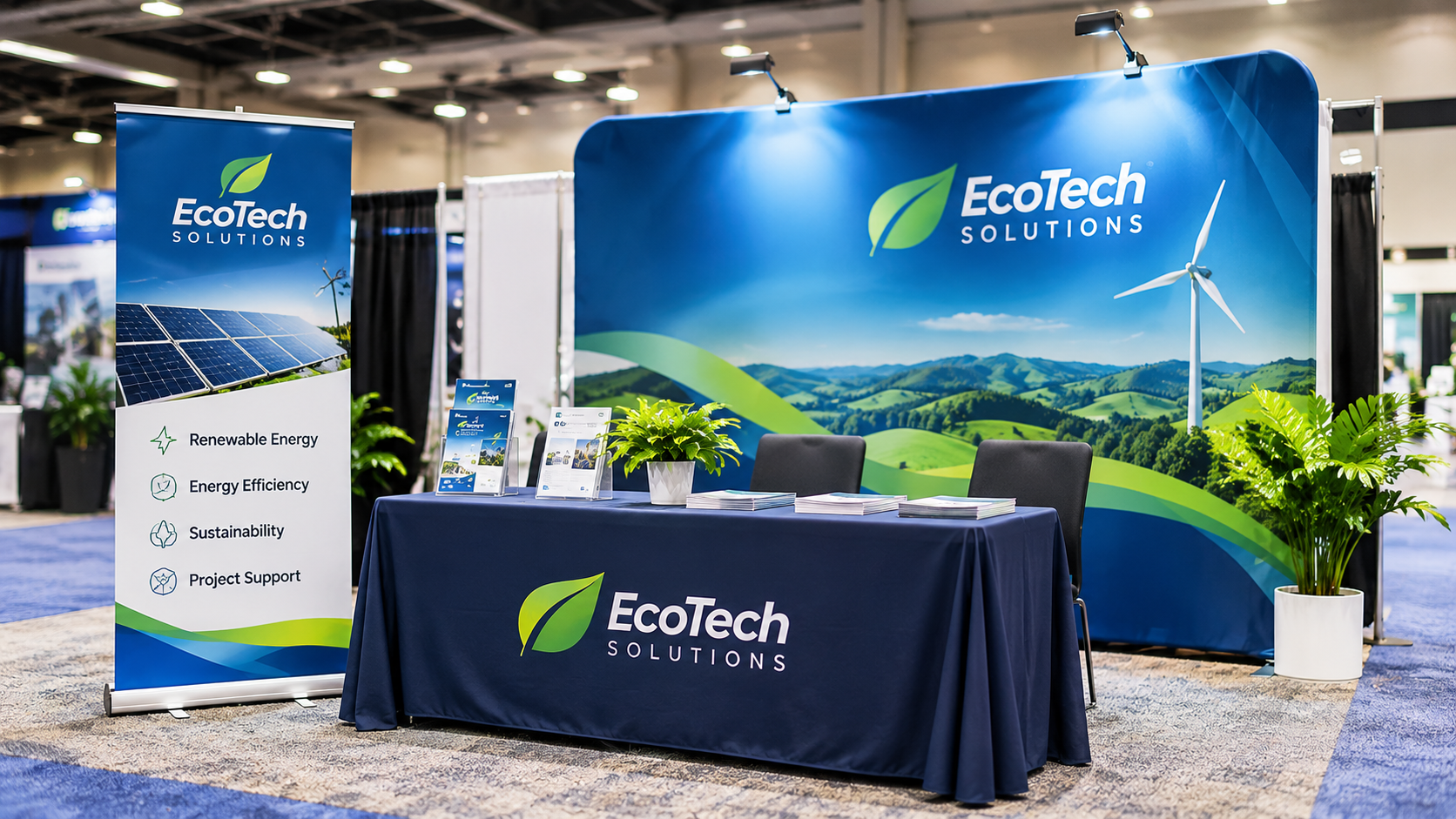
Table of Contents
Trade show graphics cost can vary significantly, even when two exhibitors request displays that look nearly identical.
Imagine two businesses preparing for the same industry trade show. Both need a branded backdrop, a tabletop display, and promotional graphics for their booths.
The first exhibitor already owns a compatible display frame and only needs replacement graphics. Their artwork is print-ready, and they plan to handle setup themselves.
The second exhibitor needs a complete display system, including new hardware, artwork adjustments, protective packing, and delivery to the event venue.
At first glance, both requests sound similar. However, the actual printing and production requirements are very different.
This is why understanding the details behind trade show graphics cost matters. Rather than comparing the final totals alone, exhibitors should understand exactly what they are purchasing.
Let’s break down the factors that influence trade show graphics cost and the questions worth asking before approving a quote.
1. Artwork Preparation and File Requirements
Before production begins, your print provider needs artwork that meets the technical requirements of your display.
Some exhibitors provide professionally designed, print-ready files. Others submit artwork that requires resizing, adjustments, or additional preparation.
Artwork-related services may include:
- Reviewing files for resolution and print quality
- Adjusting artwork to match final display dimensions
- Preparing bleed areas and safe margins
- Checking color settings and file compatibility
- Creating or modifying layouts for different display components
- Preparing separate production files for multiple graphics
The amount of preparation depends on the condition of your original files and the complexity of the requested display.
For example, a logo that looks sharp on a business card may not reproduce properly when enlarged for a large exhibition backdrop.
If the original file is low-resolution, additional design work or a suitable vector file may be necessary.
What to confirm: Ask if artwork review, file adjustments, and design revisions are included in your quote or billed separately.
Providing properly prepared files from the beginning can also help avoid unnecessary production delays.
2. Display Dimensions and Print Size
One of the most direct factors affecting trade show graphics cost is the physical size of the printed materials.
A small tabletop sign requires a different amount of material and production work than a large fabric backdrop covering an entire booth wall.
Common trade show graphic formats include:
- Retractable banner graphics
- Fabric backdrops
- Pop-up display panels
- Table throws and runners
- Hanging signs
- Counter graphics
- Floor graphics
- Custom booth wall panels
Larger displays generally require more printing material, but dimensions alone do not determine the final quote.
The number of panels, layout configuration, printing method, and finishing requirements also affect production.
For instance, a single large fabric graphic may have different production requirements than several individual rigid panels covering a similar area.
Additionally, unusually shaped displays or custom dimensions may require specialized production or finishing.
What to confirm: Request the exact width, height, quantity, and configuration of every printed component.
This makes it easier to understand the scope of the quote and verify that the finished graphics will fit your booth.
3. Printing Materials and Substrate Selection
Not all trade show graphics are printed on the same material.
The material you choose affects appearance, durability, weight, portability, and compatibility with your display hardware.
Some common options include:
Vinyl Graphics
Vinyl is frequently used for banners and other large-format applications. Different vinyl products offer varying levels of flexibility, thickness, and durability.
Fabric Graphics
Fabric is commonly used for tension fabric displays, backdrops, and portable exhibit systems.
Depending on the material and printing process, fabric graphics may offer a smooth appearance and convenient folding or packing options.
Rigid Display Panels
Foam board, PVC, and other rigid substrates can be used for informational signs, booth panels, and promotional displays.
These materials provide structure but may require additional protection during transportation.
Specialty Materials
Certain exhibits require backlit graphics, adhesive films, or materials designed for specific display systems.
These applications may involve additional production considerations.
Material selection should reflect how the graphics will be displayed, transported, stored, and reused.
For businesses attending multiple events throughout the year, durability and replacement requirements are particularly important.
What to confirm: Ask your printer to identify the exact material specified in the quote, including relevant thickness, weight, or product specifications.
4. Finishing and Display Preparation
Printing is only one part of producing a trade show graphic.
Once the artwork has been printed, it may require finishing so it can be installed, displayed, or attached to hardware properly.
Common finishing services include:
- Trimming graphics to final dimensions
- Hemming fabric or vinyl edges
- Installing grommets
- Adding pole pockets
- Sewing silicone edge graphics (SEG)
- Applying lamination
- Attaching hook-and-loop fasteners
- Preparing graphics for compatible display frames
The finishing requirements depend on the selected material and the type of display system.
For example, a fabric graphic designed for a tension frame may need sewn edges or a specific attachment method.
A vinyl banner intended for hanging may require reinforced edges and grommets.
These details are important because graphics that are printed correctly but finished incorrectly may not fit their intended hardware.
What to confirm: Review the finishing specifications and make sure they match the equipment you plan to use.
5. Display Hardware and Structural Components
One of the biggest differences between trade show quotes is the inclusion of display hardware.
A graphics-only order and a complete display system are not the same product.
Graphics-Only Orders
A graphics-only quote generally covers the printed components and their specified finishing.
This option may be appropriate when you already own compatible frames, stands, or display structures.
For example, you might order replacement fabric for an existing backdrop frame rather than purchasing an entirely new system.
Complete Display Systems
A complete display system may include both printed graphics and the equipment required to display them.
Depending on the selected product, this could include:
- Retractable banner stands
- Aluminum display frames
- Tension fabric structures
- Pop-up display hardware
- Counter or podium structures
- Mounting accessories
- Carrying cases or transport bags
Different systems also vary in construction, portability, assembly requirements, and replacement graphic compatibility.
When comparing quotes, confirm that the proposed hardware is suitable for your booth space and intended use.
What to confirm: Ask for an itemized list identifying every graphic, frame, stand, accessory, and carrying case included in the proposed system.
6. Packing and Shipping Requirements
Trade show displays often need to travel from the print facility to an office, warehouse, convention center, or event venue.
Shipping requirements can affect the overall project quote, particularly for large, heavy, or fragile components.
Factors that may influence packing and transportation include:
- Package dimensions and total weight
- Number of cartons or cases
- Protective packaging requirements
- Shipping destination
- Delivery deadline
- Freight handling requirements
- Special venue receiving instructions
A lightweight fabric graphic packed separately may have different transportation requirements than a complete display system containing rigid panels and structural hardware.
Convention centers may also have specific receiving procedures, delivery windows, or designated freight contractors.
Some events require shipments to arrive at an advance warehouse before being transferred to the exhibition floor.
These arrangements may involve separate charges from the event organizer or its service providers.
What to confirm: Determine if the quote includes packing, shipping, freight coordination, and delivery to the required destination.
Also ask about any event-related receiving or material-handling charges that are not included.
7. Installation and On-Site Support
Some trade show displays are designed for straightforward self-assembly.
Others require additional installation support, particularly when the booth includes large structures, suspended signage, or multiple interconnected display components.
Depending on the project, installation-related services may include:
- Pre-event display assembly
- On-site graphic installation
- Hardware setup
- Coordination with venue personnel
- Display dismantling
- Packing assistance after the event
Installation is not automatically included in every printing quote.
A print provider may supply completed graphics and hardware while leaving the final setup to the exhibitor.
For more complex projects, installation may be handled by a separate exhibition contractor.
It is also important to review event-specific labor rules, especially at venues with designated installation service providers.
What to confirm: Ask who is responsible for assembly, installation, dismantling, and any required venue labor.
Clarifying these responsibilities early helps avoid confusion when the event approaches.
8. Production Schedule and Delivery Deadlines
The time available to produce your graphics can also influence your quote.
Trade show projects often involve firm deadlines because materials must arrive before exhibitor setup begins.
A standard production schedule may provide enough time for artwork review, printing, finishing, quality checks, and shipping.
A project with a shortened timeline may require expedited production or transportation, subject to the printer’s capabilities.
Other scheduling considerations include:
- Artwork approval dates
- Production lead times
- Material availability
- Shipping transit time
- Venue receiving deadlines
- Time needed to inspect the completed display
Late artwork changes can also affect the production schedule.
For this reason, exhibitors should communicate their event dates and required delivery deadlines before requesting a final quote.
What to confirm: Request the expected production timeline, artwork approval deadline, and shipping arrangements in writing.
Understanding an Itemized Trade Show Graphics Quote
To see how these factors work together, consider a hypothetical exhibitor preparing for a standard booth at an upcoming industry event.
The exhibitor needs a branded backdrop, one retractable banner, and a printed table throw.
Instead of requesting a general price for trade show graphics, the exhibitor asks for a quote with clearly defined components.
Here is an example of how that scope might be organized.
| Quote Component | Hypothetical Scope |
| Artwork preparation | File review and adjustments for three display graphics |
| Backdrop graphics | One custom-printed fabric backdrop |
| Backdrop hardware | One compatible display frame |
| Retractable banner | One printed banner with a compatible stand |
| Table throw | One custom-printed table covering |
| Finishing | Required hemming, trimming, and attachment preparation |
| Packing | Protective packing for printed graphics and hardware |
| Shipping | Delivery to the exhibitor’s business address |
| Installation | Not included; exhibitor handles setup |
This example is illustrative only. It does not represent actual pricing, a formal quotation, or a guarantee that any particular service is included.
Now imagine another exhibitor requests the same three printed items but already owns the backdrop frame and retractable banner stand.
Their quote might cover replacement graphics, the table throw, finishing, and shipping without new hardware.
Although the finished booths could look similar, the purchasing requirements are different.
This is why comparing total quotes without reviewing the scope can be misleading.
How to Compare Trade Show Graphics Quotes Accurately
When evaluating multiple printing providers, the goal should be to compare equivalent products and services.
A lower total may reflect fewer components, different materials, or services excluded from the proposed scope.
Before selecting a provider, ask the following questions:
- Are the dimensions and quantities identical?
Verify that each quote includes the same number of graphics, sizes, and display components.
- Are the printing materials comparable?
Confirm the material specifications and intended applications rather than relying on general descriptions.
- Does the quote include display hardware?
Determine if you are purchasing replacement graphics or an entirely new display system.
- What artwork preparation is included?
Ask about file reviews, design adjustments, proofing, and additional revisions.
- Are finishing requirements included?
Check that trimming, hemming, grommets, attachments, and other required finishing services are accounted for.
- How will the graphics be packed and shipped?
Clarify packaging, freight charges, delivery arrangements, and any excluded venue fees.
- Who handles installation and dismantling?
Identify the responsibilities of your team, the printer, and any event contractors.
- What is the expected production and delivery schedule?
Confirm deadlines, approval requirements, and any expedited services.
- What happens if replacement graphics are needed later?
Ask about hardware compatibility and the process for ordering additional or replacement components.
These questions make it easier to identify differences in scope and select a solution that meets your event requirements.
Get a Clearer Picture of Your Trade Show Graphics Cost With Digital Arts Imaging
Understanding trade show graphics cost starts with knowing exactly what your project requires.
From artwork preparation and material selection to display hardware, finishing, and shipping, every detail contributes to your final quote.
At Digital Arts Imaging, we understand the importance of having professional, high-quality graphics that represent your brand at trade shows, exhibitions, and industry events.
Our team can help you explore printing options, review your display requirements, and understand the details behind your quote so you can plan your next event with confidence.
Preparing for an upcoming trade show?
Contact Digital Arts Imaging today to discuss your trade show graphics and request a customized quote for your next event.
Frequently Asked Questions About Trade Show Graphics Cost
What affects trade show graphics cost the most?
Major factors include display dimensions, printing materials, finishing requirements, hardware, artwork preparation, and shipping. The overall scope of the project determines which components contribute to the final quote.
Is it possible to order trade show graphics without buying new hardware?
Yes. Many display systems support replacement graphics. However, compatibility must be confirmed before ordering, especially when using existing frames or stands.
Are shipping and installation included in trade show display quotes?
Not necessarily. Some quotes include packing and delivery, while installation and venue-related services may be separate. Always request a clear explanation of included and excluded services.
Why do two printers provide different quotes for similar displays?
Quotes may differ because of material specifications, hardware quality, finishing methods, artwork requirements, production schedules, and included services. Comparing itemized scopes provides a clearer picture than comparing totals alone.
What information should I provide when requesting a trade show graphics quote?
Share your booth dimensions, required graphics, quantities, artwork files, existing hardware details, preferred materials, event location, and delivery deadline. Providing these details helps your printer develop a quote based on your actual requirements.